
Preventing Cervical Cancer: The Development of HPV Vaccines
Key Points
- More than half a million women around the world are diagnosed with cervical cancer each year. Over half of them will die of the disease. Most of these cases and deaths occur in low- and middle-income countries.
- Researchers supported by the National Cancer Institute (NCI) helped establish that human papilloma virus (HPV) is a major cause of cervical cancer, carried out studies to determine how HPV causes cancer, and developed the technology used to create the first HPV vaccines.
- Research is under way to develop the next generation of vaccines, including one that could prevent 90 percent of cervical cancers worldwide.
Pathway to Discovery
As far back as the nineteenth century, the prevailing thinking was that a sexually transmitted agent causes cervical cancer. It took more than 100 years to identify the culprit. In the 1980s, researchers at the German Cancer Research Center found types of HPV in many cervical tumors. HPV’s role in cervical cancer seemed possible, as other viruses in the HPV family were already known to cause warts. Consequently, scientists—including many supported by NCI and in the NCI Intramural program—began to explore whether HPV could cause cancer; and if it did, scientists wanted to understand how the virus could cause cancer.
NCI achieves a key milestone. A team of NCI researchers led by Joe DiPaolo, M.D., and Jay Donniger, Ph.D., was among the first to show that DNA from HPV 16, the type of HPV found most often in cervical cancer cells, was able to cause cancer-like traits in cells grown in the lab. These researchers also showed that HPV 16 and mutations (cellular transformation) caused tumors to develop. This finding suggested that several mutations or alterations needed to take place in the cell at the same time to lead to cancer.
Nearly all cervical cancers are caused by HPV. In the early 1990s, two large epidemiological studies were conducted: one by NCI intramural researcher Mark Schiffman, M.D., and another by a group at the NCI-designated Albert Einstein Cancer Center. Using what was then a new DNA technology, these studies showed that a select group of HPV types is responsible for premalignant abnormalities found in Pap smear screening and for the development of most cervical cancers. Later studies showed that nearly all cervical cancers are caused by HPV.
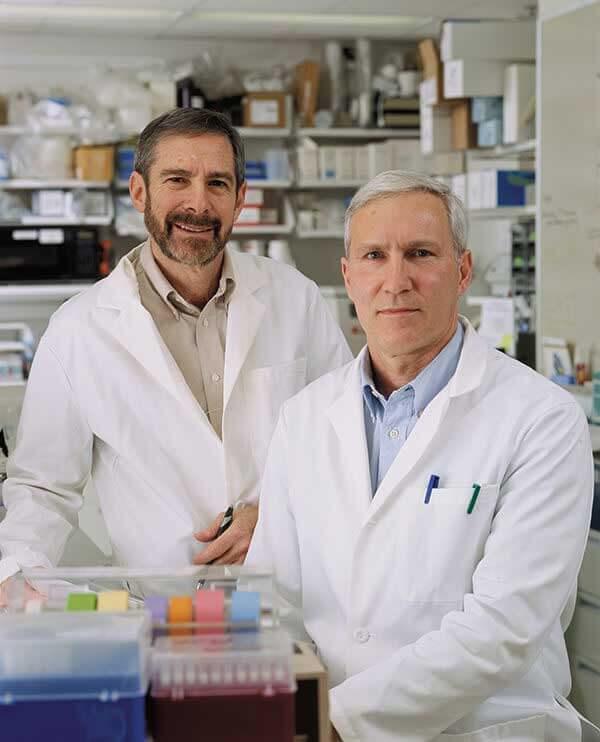
NCI researchers Douglas Lowy, M.D., and John Schiller, Ph.D., pioneered discoveries that led to the development of the HPV vaccine. Credit: R. Baer
One big hurdle was that HPV produces a local genital infection and all prior attempts to develop vaccines for this type of infection had failed. In addition, a vaccine needs to be very safe, and HPV contains genes (oncogenes) that can cause cancer to develop. Scientists also did not know how to produce large quantities of the outer shell of the virus in a way that would produce antibodies that may protect against other types of infection. Consequently, researchers turned to creating something that looked like HPV but did not include the potentially dangerous genes contained within HPV.
With NCI’s support, the impossible is made possible. In the early 1990s, two research groups—including one led by Drs. Lowy and Schiller, and another laboratory supported by NCI grants—independently discovered that the proteins that form the outer shell of HPV could form particles that closely resemble the original virus and create high levels of potentially protective antibodies but are not infectious because they lack the viral genes. These virus-like particles became the basis of several subsequent HPV vaccines, including Gardasil®, Cervarix®, and Gardasil® 9. All three vaccines are approved for the prevention of cervical cancer and other conditions caused by certain types of HPV.
When we started this work, there was no greater optimism for an HPV vaccine than there was for an HIV vaccine. In fact, there was skepticism that it could work at all.
Enhancing Cancer Prevention
Phase III clinical trials in young women found that Gardasil and Cervarix can prevent infection with HPV types targeted by the vaccine and prevent the development of precancerous lesions. The initial Gardasil study was so successful it was stopped early so that participants in the placebo group could also be offered the vaccine. The HPV Vaccine Trial in Costa Rica, a collaboration between investigators in Costa Rica and at NCI, demonstrated that two, and even a single, dose of Cervarix may provide a similar level of protection as the recommended three doses of the vaccine.
NCI is conducting a long-term follow-up study of women who participated in the Costa Rica trial to answer many more questions about vaccination with Cervarix, such as the extent and duration of protection.
Currently, more than 500,000 women around the world are diagnosed with cervical cancer each year and 275,000 will die of the disease. The vast majority of these cases and deaths occur in low- and middle-income countries. It has been estimated that widespread vaccination using currently available HPV vaccines could prevent more than two-thirds of cervical cancers.
Turning Discovery into Health

NCI-supported research helped establish HPV as a major cause of cervical cancer.
Although current HPV vaccines have an excellent safety record, getting people vaccinated has lagged in the United States. Research on strategies to disseminate the vaccine could help address this problem, as could efforts to enhance access to the vaccine in both developed and developing countries. Increasing awareness that the vaccine can prevent other cancers as well as cervical cancer may also help. Other research is looking at ways to simplify how the vaccines are administered to increase acceptance by the general population.
The ability of Gardasil to prevent genital warts, anal dysplasia, and anal cancer in males led to its approval by the FDA for men as well as women. Further studies showed that two doses of the HPV vaccine can be as effective as three. The FDA, consequently, approved a two-dose regimen of Gardasil 9 for boys and girls ages 9 to 14 years old. The two-dose regimen could be very important for implementing vaccinations both in the United States and globally.
Research to Practice: NCI’s Role
NCI-supported researchers helped establish HPV as a major cause of cervical cancer, carried out studies to determine how HPV causes cancer, and developed the technology used to create the first HPV vaccines. NCI scientists also were involved in the initial trials of Cervarix and are contributing to ongoing clinical studies of the vaccine.
Source: www.cancer.gov